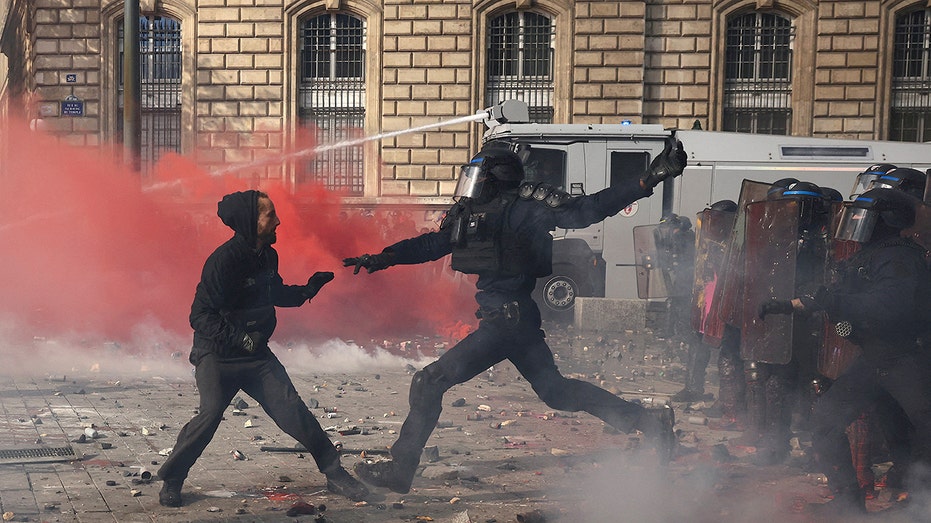
Violent clashes broke out across France on Saturday as demonstrations entered a fourth week. Earlier in the week, President Emmanuel Macron made some of his most direct comments yet on the protests as he enters his final six months in office.
In his weekly cabinet meeting, Macron “stressed that young people have legitimate concerns,” government spokeswoman Maud Bregeon told the AFP, “but these are being exploited for political purposes and turned into urban violence.” Bregeon added that Macron called on his ministers to come up with “concrete responses” to the unrest within weeks.
This comes as a national day of protest over rising costs of living and additional student grievances led to violence in Paris and other major cities today. While many of the protests were without violence, police used tear gas and water cannons to disperse violent groups in the capital, where people wearing hoods and masks threw fireworks and other objects at officers in the Place de la République. The interior ministry reported assaults on police, looting and damage to public buildings, saying there have been at least 272 arrests nationwide.
FRANCE EXPLODES AGAIN AS STUDENTS RIOT OVER EDUCATION
French Prime Minister Sébastien Lecornu took a more direct approach than Macron, saying the student movement has been “instrumentalized by the allies of France Unbowed (LFI)… for electoral reasons.” The left-wing LFI’s presidential candidate, Jean-Luc Mélenchon, even participated in one of the Paris protests this week, while LFI councilors, deputies, and mayors have joined student blockades in multiple cities.
Elections to replace the term-limited Macron are set for April and May, and opposition parties have seized upon the ongoing unrest. Leading candidate Marine Le Pen, of the conservative National Rally party, has voiced support for the police, blaming students for any violence.
BEHIND FRANCE’S STUDENT RIOTS: COMMUNISTS, UNIONS AND A GLOBAL PROPAGANDA NETWORK
Meanwhile, students, unions, rights groups and parents have accused the police of using excessive force against the students.
According to the AFP, the interior ministry has opened internal investigations into 36 allegations of police officer violence against demonstrators. But the national police union, Alliance Police Nationale, says it has filed a lawsuit against the government for “putting lives in danger” over what it called “contradictory orders” given to officers deployed in the protests.
The Alliance says officers felt “betrayed, abandoned, left to fend for themselves” by their political leaders because of their “unclear instructions” and what they said were public expressions of “empathy towards the rioters.”
“This is the country of the French Revolution. Everyone boasts about it,” police officer and union representative Walid Hrar told The Associated Press. “Some political parties don’t hesitate to say that we need to disobey the law. That’s what Robespierre and other revolutionaries taught us in 1789.”
FRANCE IS DEVOURING ITSELF AS SCHOOL RIOTS REVEAL A CRISIS FAR BIGGER THAN BROKEN CLASSROOMS
“France always tends to react rather than anticipate,” he added. “In other words, we’re always going to extremes.”
On the sidelines of Friday’s European Council summit in Brussels, Macron again called for calm, saying, “There is a constitutional right to protest and to express oneself. But this right comes with the need to respect. Respect for people, respect for property, and therefore a commitment not to insult or destroy.”
Lecornu told Parliament that 937 police officers and 149 teachers and school staff have been injured since the protests began, while the French justice ministry reports that nearly 8,000 people have been arrested.
Protests have also spread to neighboring Belgium. Several hundred mostly young people protested in Brussels today, according to Reuters, clashing with police in protests at least partly inspired by what is going on in France. A similar protest occurred in the French-speaking city of Liege. Student groups say they are protesting rising education costs and reforms they say will make higher education less accessible.
Belgian Interior Minister Bernard Quintin posted on X that what is happening in his country: “is no longer mere protest! It is pure and simple violence, organized and repeated to destabilize our society… All necessary means will be used to restore order in the face of the rioters.”
Small solidarity events have also taken place in neighboring Luxembourg and the French-speaking parts of Switzerland, but they have been peaceful with no arrests reported. Student protests also occurred in India this week over education issues there, but they do not appear to be linked to the protests in France.
French authorities have expressed hope that the protest movement will ease in coming days as schools nationwide are closed until Nov. 2 due to the Toussain, or All Saints’, holiday.
The Associated Press and Reuters contributed to this report.