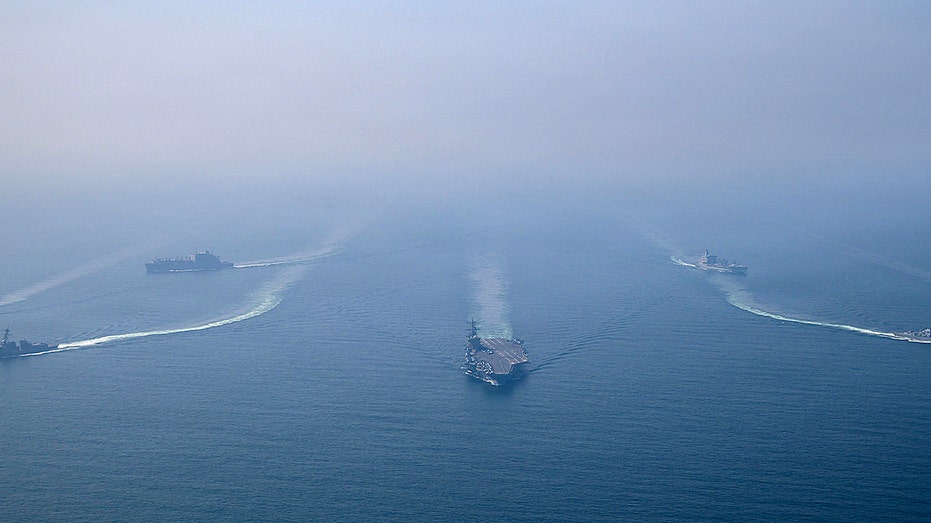
The U.S. is in position for a “highly kinetic” campaign against Iran after launching one of its largest recent military buildups in the Middle East, a former senior Pentagon official has claimed.
Dana Stroul, now research director at The Washington Institute for Near East Policy, made the assessment Sunday as Washington and Tehran prepare for a second round of indirect nuclear talks in Oman.
“The US military is ready for a sustained, highly kinetic campaign should President Trump order it, and also prepared to defend allies and partners in the Middle East from Iran’s missiles,” Stroul told Fox News Digital.
“The US military can rapidly reposition assets from all over the world and deploy overwhelmingly lethal force in a short period of time to one theater,” she said before highlighting how there is “no ally or enemy capable of what we have seen from the US in this current buildup.”
PRESIDENT TRUMP’S IRAN BUILDUP MIRRORS 2003 IRAQ WAR SCALE AS TENSIONS ESCALATE
Describing how the current posture differs from the June 2025 strikes on Iranian-linked nuclear targets, Stroul said the U.S. has expanded its offensive and defensive capabilities.
“Two US aircraft carriers and their accompanying vessels and air wings were stationed in the Middle East last summer during the 12-day war and the US operation Midnight Hammer,” she explained.
“The addition of the Ford is really important, it expands US offensive capabilities if we go to war with Iran,” she said.
While in June 2025, the US carried out limited but highly targeted strikes against Iranian nuclear infrastructure to degrade key facilities without triggering a regional war, now, Stroul said the force posture is broader and more sustained.
The US has also “increased the number of guided-missile destroyers, fighter aircraft, refuelers, and air defense systems” in the region, she explained.
TRUMP SAYS IRAN HAS 15 DAYS TO REACH A DEAL OR FACE ‘UNFORTUNATE’ OUTCOME
The deployment of aircraft carriers such as the USS Gerald R. Ford and USS Abraham Lincoln has assumed heightened strategic importance.
The USS Gerald R. Ford was recently tracked transiting the Strait of Gibraltar eastward, while the USS Abraham Lincoln is operating in the Arabian Sea.
“They will both be in the Middle East CENTCOM theater,” Stroul explained before clarifying that there could be “one in the eastern Mediterranean and the other in the Arabian Gulf.”
“There would probably be a combination of reasons for that based on availability, readiness, proximity to the Middle East.
“The Ford was heading home and directed to turn around,” she added.
While the specific destinations of the carriers have not been publicly disclosed for operational security reasons, their presence alone signals escalatory leverage and deterrence.
WITKOFF WARNS IRAN IS ‘A WEEK AWAY’ FROM ‘BOMB-MAKING MATERIAL’ AS TRUMP WEIGHS ACTION
The military buildup comes as indirect diplomatic talks between Washington and Tehran continue, with Oman once again serving as a mediator Feb. 26.
Stroul argued that Iran’s leadership is trying to balance brinkmanship with negotiation.
“Iran’s leaders are playing a weak hand by combining saber-rattling about their own capabilities, staging preparations and exercises to signal readiness,” she claimed.
“They are attempting to slow this down by pursuing negotiations. No one should be under any illusions about the reality of US dominance — Iran is completely outmatched in conventional terms,” Stroul said.
BUILT FOR WEEKS OF WAR: INSIDE THE FIREPOWER THE US HAS POSITIONED IN THE MIDDLE EAST
“Israel dominated Iranian airspace in one day last year, targeted many of Iran’s security leaders, took out half of its missile arsenal, and the US significantly set back its nuclear program,” Stroul said.
Iran’s long-cultivated network of proxies across the region — including Hezbollah, Shiite militias in Iraq, and elements in Syria — has also been weakened after sustained Israeli military pressure.
“Iran’s long-cultivated network of proxies across the region is degraded after more than two years of Israeli operations, and they declined to enter the war and support Iran’s defense last summer,” Stroul explained.
“No matter what Iran’s leaders say, Iran is not able to rebuild a decades-long project in a few months.”
“That said, the US military is in a position to execute whatever orders President Trump gives,” she said. “It is not a question of military readiness, but a political decision.”